

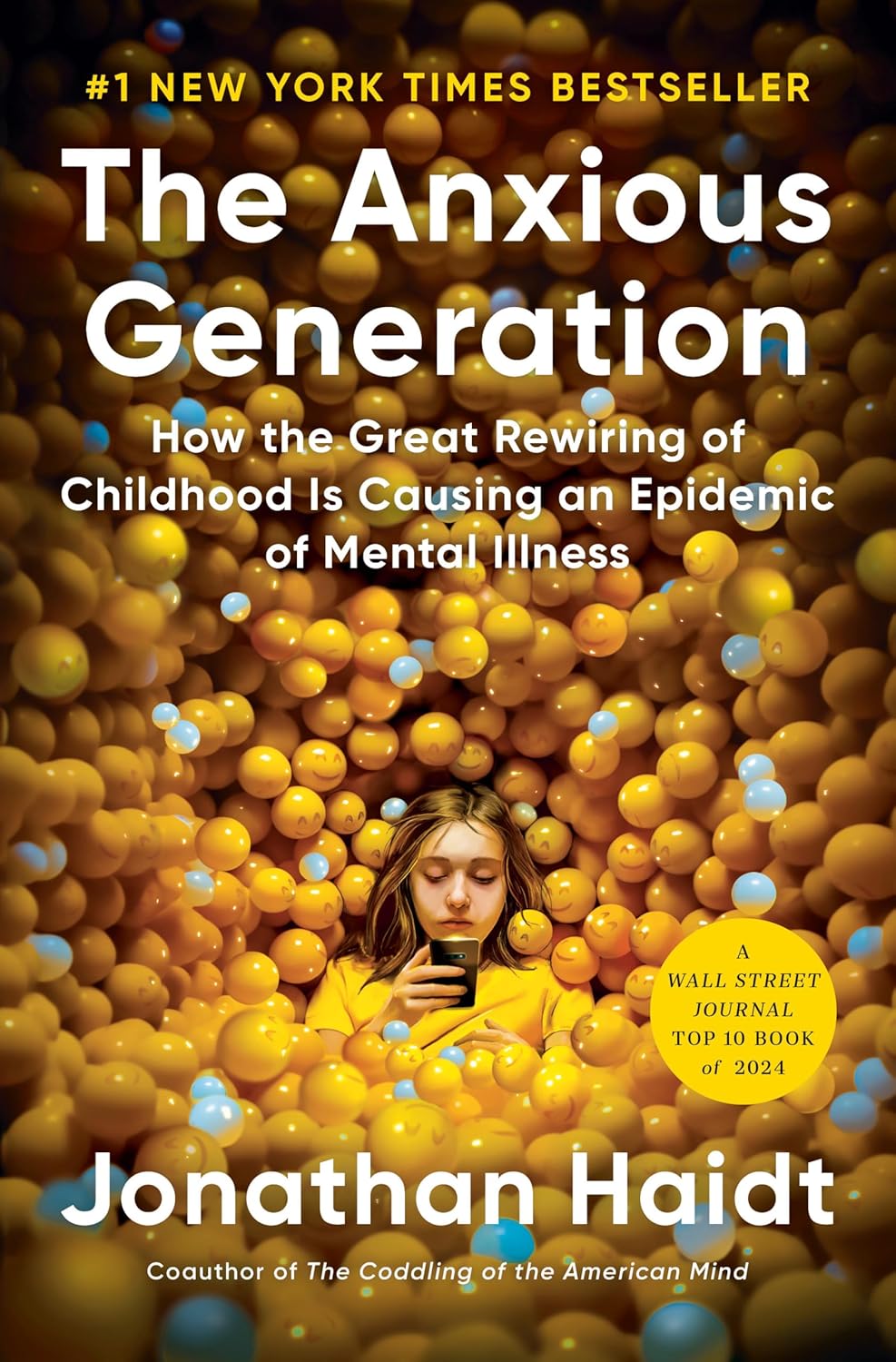
 We’ve got a problem. And, as Jonathan Haidt attests in The Anxious Generation, we are holding it in the palm of our hands. The arrival of smartphones in 2007, coupled with the development of social media shortly after, has had a deeply significant—and too often deeply toxic—impact upon us all. No generation, however, has felt the negative impact of a phone-based life as much as those born after 1995. Or, as Haidt labels them, “The Anxious Generation” (6).
Haidt asserts that the advent of smartphones—and the unlimited ability they provide to access social media and all other internet-based activities at any time and from anywhere—has rewired the brains of our youth. This “Great Rewiring of Childhood” “is the single largest reason for the tidal wave of adolescent mental illness that began in the early 2010s” (44).
As problematic as the arrival of the smartphone has been for the mental health of our youth, Haidt doesn’t begin his story in the virtual world. The root of the problem, he claims, began in the real world, as children in our society have gradually lost the freedom to enjoy the “play-based childhood” they need to develop the appropriate skills needed for adult life (45).
Haidt demonstrates that, beginning in the 1980s, children have not been allowed to experience enough “free play,” which is largely unsupervised play that naturally contains an element of risk (52). Instead, a parenting style Haidt calls “safetyism,” where a child’s “safety trumps everything else, no matter how unlikely or trivial the potential danger” (89), has interfered with our children’s ability to develop necessary skills such as risk-assessment, resilience, and self-reliance. “All children are by nature antifragile,” Haidt says. “Just as the immune system must be exposed to germs, and trees must be exposed to wind, children require exposure to setbacks, failures, shocks, and stumbles in order to develop strength and self-reliance. Overprotection interferes with this development and renders young people more likely to be fragile and fearful as adults” (93).
Haidt then connects this groundwork of “overprotection in the real world” (9) to an equally problematic parenting trend that developed once smartphones, social media, and other internet-based activities burst onto the scene in the 2000s—”underprotection in the virtual world” (9). Haidt concluded that as parents were keeping a close protective eye on their children “in the real world” as they sat on their smartphones in the safety of their own homes, they were unknowingly allowing their children to venture out into the far more dangerous waters of “the virtual world” unchecked.
Haidt then uses the extensive amount of research he did on the topic to highlight four main foundational harms that youth experience because of the time they spend on smartphones and the content they consume while using them: social deprivation (120–123), sleep deprivation (123–125), attention fragmentation (125–129), and addiction (129–136). “When we put these four foundational harms together, they explain why mental health got so much worse so suddenly as soon as childhood became phone-based” (141).
Jonathan Haidt, however, isn’t just interested in identifying problems. He wants to be a part of the solution. In the final chapters of his book, he offers several proposed solutions to different segments of society. “Governments at all levels need to change policies that are harming adolescent mental health and support policies that would improve it” (244). This includes, for example, policies that allow parents to give their children proper independence and more unsupervised play time without risking arrest or state intervention, as well as laws that raise the age of “internet adulthood” to 16 (234). Haidt then urges tech companies to develop better age verification features for the phone applications they create and to enforce those restrictions more strictly (244).
Haidt then explains the integral role that schools and parents can play in the solution. Schools need to become “phone-free” and “play-full” (248–254). Phones should be locked away for the entire day, Haidt urges. Children should be allowed more recess, on better playgrounds, with fuller autonomy and independence given to the children as they play (256–261). Parents, meanwhile, should give their children more opportunities for unsupervised play. They should also delay their child’s full entry into a phone-based childhood by delaying the age at which they get their first smartphone (286–287). Haidt adds that coordinating these healthy behaviors in a unified effort with other parents will help overcome opposing pressure from society, other parents, and their own children (287).
Haidt concludes that the collective action of these four main groups will promote healthier childhoods, both for the current “anxious generation” that has grown up with a phone-based childhood instead of a play-based one, and for all generations of children that follow.
We’ve got a problem, indeed. Has Jonathan Haidt put his finger on precisely what it is? As I read Haidt’s clear communication of his extensive research (Haidt’s book is filled with data, charts, and eighty-five pages of endnotes), alongside his thoughtful analysis and the conclusions he drew from his research, I believe he has. His research, analysis, and conclusions about the dangers of replacing a play-based childhood with a phone-based childhood accurately mirror what I often witness as a parent and pastor in our current society. I am convinced that most who read Haidt’s book will also agree.
Has Haidt put his finger on solutions, as well? I believe he has done that, too. His advice for governments, tech companies, schools, and parents is also rooted in research, and the solutions he encourages are realistic, reasonable, and attainable. He calls for specific collective actions that we as individuals and as a society working together can begin to implement immediately.
At the same time, the child of God who reads Haidt’s book will want to remember this: Jonathan Haidt has identified what a Christian might properly label a “small p” problem, and he is suggesting “small s” solutions to fix it. We know from Scripture that the brokenness Haidt describes within “the anxious generation” (and in every generation alongside them) is ultimately just a symptom of our “big P” problem of sin – a problem that can only be (and has been!) solved by the “Big S” solution of the substitutionary life, death, and resurrection of Jesus Christ.
As I read Haidt’s excellent work, I kept returning to the same thought: “This is the natural knowledge of God at work.” Scripture teaches us that human hearts are naturally aware of our sin-broken relationship with God. Scripture also teaches us that we have a natural desire to fix the brokenness. Haidt himself, who professes to be an atheist (201), acknowledges in his chapter entitled Spiritual Elevation and Degradation that “there is a hole, an emptiness in us all, that we strive to fill” (216). He even agrees that it is a “God-shaped hole” (215), which leads people to “feel a yearning for meaning, connection, and spiritual elevation” (218). “If [this God-shaped hole] doesn’t get filled with something noble and elevated, modern society will quickly pump it full of garbage,” Haidt concludes. “That has been true since the beginning of the age of mass media, but the garbage pump got 100 times more powerful in the 2010s” (216).
Without even knowing it, Haidt is describing what it means to lose the image of God with which we were created. He is also acknowledging our deep-seated desire to get it back, as well as the strivings we undertake to try and do so. Apart from the “Big S” solution of Christ, though, who truly restores in us the image of the one true God through his redeeming work on our behalf, full and genuine restoration of what sin has broken is impossible. The best sinful humans can do apart from Christ is to blindly search and search and search for ways to temporarily patch the “small p” symptoms of the brokenness that we identify with “small s” solutions.
This does not make Haidt’s work invalid, however. In fact, far from it. As stewards of life and health, we have a God-given responsibility to care for the physical and mental well-being of the souls entrusted to our care. That responsibility becomes even stronger when the dangers Haidt identifies in his book are currently some of the most effective tools our spiritual enemies may wield as they try and separate human beings in all generations from God. Haidt’s research, analysis, and conclusions, then, should be even more relevant for the Christian as we strive to care for bodies and souls according to God’s will.
I encourage principals and teachers to read “The Anxious Generation” and implement the proposals he makes for schools in chapter 11. I urge parents and prospective parents to collectively rally together around Haidt’s encouragements for parents in chapter 12. I ask all citizens to consider Haidt’s suggestions for governments and tech companies in chapter 10. We can then exercise our rights to influence these entities to implement Haidt’s suggestions for the overall well-being of our society. As we do, our care and concern for providing “small s” solutions to the “small p” problems created by sin can lead us to an even more fervent zeal to bear witness to the “big S” solution of our Savior from sin, Jesus Christ.