

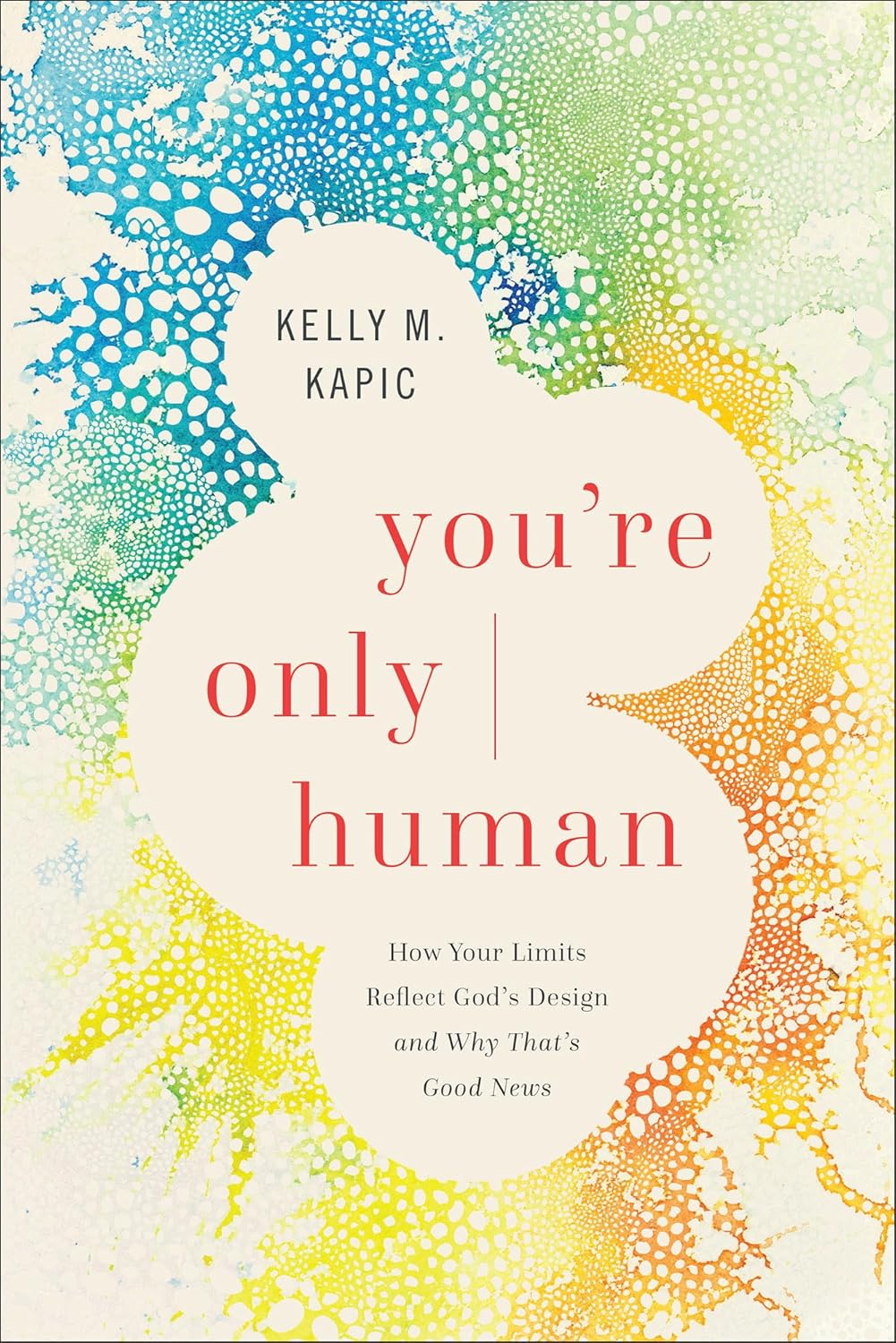
 Do you feel overburdened by all the tasks you need to complete? Do you feel that you are falling short of your aspirations, or worn down by the inability to focus on what truly matters? Do you wish God had made you differently—capable of achieving more, without the consequences of overwork? It can be easy to find oneself envious of another’s lifestyle or work habits. Envy gets in the way of praise. It leads us to covet and grumble.
These are the issues Kelly Kapic’s You’re Only Human tackles. Focusing on what human finitude is and the blessings that accompany our limitations, You’re Only Human addresses five major questions and explores five ways God designed us to have a healthy dependence on others, mainly Christ, to break through our feelings of inadequacy.
In the opening chapter, Kapic states his two-fold goal: 1) We are not required to be infinite; this quality is reserved for God alone. But we are called to love those who are finite. 2) We don’t need to ask for forgiveness when we can’t get everything done (14). Kapic clarifies, however, that these insights are not a license for laziness.
A central point repeated throughout the book is that our human limitations are not sin. Even at creation, Adam was created to depend on God. God brought Eve into the world since it was not good for man to be alone. There was a mutual good for man and woman to depend on one another. In this way, Kapic helps us see that limitations are not evil, but that God has built healthy dependence as a staple in each of our lives. Sin, of course, distorts that dependency, luring people into believing they can be self-made or self-sufficient. But our human limitations give us reason to praise God that he would still send Jesus for us in the flesh, thus confirming that our human existence is good and that he loves us (43).
Kapic spends an entire chapter (five) on being thankful for belly buttons, which on the surface seems superficial. But our connection to other human beings is a blessing, and a belly button is a tangible reminder of it. Even Christ had a belly button, and for a time, he had to rely on Mary to sustain him. By means of these reflections, Kapic warns of the dangers of Docetism and Gnosticism and encourages us to regularly ponder the implications of Christ’s incarnation. Such ponderings serve to grow one’s acceptance of human limitations.
Kapic maintains a general focus on praise and gratitude for everything God has done. Each chapter finds its resolution not in what we might accomplish, but what God has made us to be in Christ. I am appreciative of Kapic’s high view of Scripture and the sacraments, even alluding to infant baptism on page 5 of the book! There are plenty of nods to John Calvin, but this book is not a doctrinal treatise. Kapic regularly quotes many church fathers and theologians throughout the centuries to give a well-balanced report of how the church has handled the dependencies that result from human finitude.
I did find the premise of chapter two to be a response to bad homiletical practices in churches familiar to Kapic more than what Lutheran readers would expect to find in their pulpits. Kapic frets about preaching that pits a wrathful Father against a loving Son, leaving sinful humans to be endured by the Father because of the Son, but not truly loved. After setting aside the obvious trinitarian misunderstanding present in this scheme, Kapic proceeds to an analysis of Galatians 2, where Paul speaks of dying to the law and being crucified with Christ. Who lives then? Me or Christ? The glorious answer is the Christ lives in me, and that this union with Christ means that I am not merely endured by the Father but loved and received by him.
I wouldn’t have any issues recommending this book to pastors or laypeople. Its emphasis on Christ’s redemptive work, our identity in him, and the blessings of interdependence make it a worthwhile read. I believe You’re Only Human would be a helpful companion for a pastor who regularly counsels those who are facing the struggles of an ever-demanding workforce and society. The pressures of everyday life easily can erode the confidence that one truly is a child of God and that God is in control. Kapic’s book will help those struggling with guilt over not doing enough or experiencing shame about needing help. You’re Only Human regularly delivers this gospel truth: God did not design us to do everything, but to depend on him who has done everything for us.