


I didn’t carve out quiet time with the Lord today. I haven’t prayed yet. I skipped lunch. I’ve spent way too much time scrolling on my phone. I’m tired and distracted and I’m not keeping up. Sound familiar? It’s the all-too-common day’s review for believers who want to follow Jesus yet get pulled so many directions. It can make days and weeks feel aimless. And it often leads to one result: Guilt. Guilt. Guilt.
Justin Whitmel Earley understands that kind of guilt and exhaustion well. He knows well the dangers of burning the candle at both ends without proper care for body, mind, and soul. The Common Rule is the product of learning the hard way and finding God’s grace and strength in burnout.
The “rule” of The Common Rule is an old school use to the term, much like the Rule of Saint Augustine and the Rule of Saint Benedict. From the Latin regula, associated with a bar or trellis, this “rule” is meant to be a guide for growth in Chrisitan life. Earley says that, like a vine, we’re all growing throughout our lives. But that growth isn’t necessarily ordered, healthy, or heading in the right direction. Earley argues that habits are the trellis (or rule) upon which we can grow in healthy ways that allow us to love God and love our neighbor as we were intended. Habits, he says, are liturgies of our lives: “We are all living according to specific regiments of habits, and those habits shape most of our life….Habits form much more than our schedules: they form our hearts” (7). Picking up on habit-shaping “rules” for life that were common in monastic communities, Earley posits a common rule—a suggested set of daily and weekly habits not just for monks, but for everyday Christians. These suggested habits are meant for the common man and woman in our day; people who struggle to find time to pray, who are addicted to their phones and bombarded with media messaging, and who want to grow in their faith life, but find that so much easier said than done.
Earley suggests forming eight habits (four daily and four weekly, with a chapter devoted to each) as a way of orienting our hearts and lives toward God and our neighbor in love. He advises doing these in community, not merely practicing them on our own. He believes that “The connection between the ordinary and the extraordinary is through very small habits” (164). And while he uses the term “rule,” he doesn’t speak of them as hard and fast rules but rather habits and life tendencies. He says that the goal is to make these the norm in life, recognizing we all struggle and fail to follow them at times. However, over time, they could potentially become the pattern we most naturally follow, which is healthier for our bodies and souls than our natural inclination.
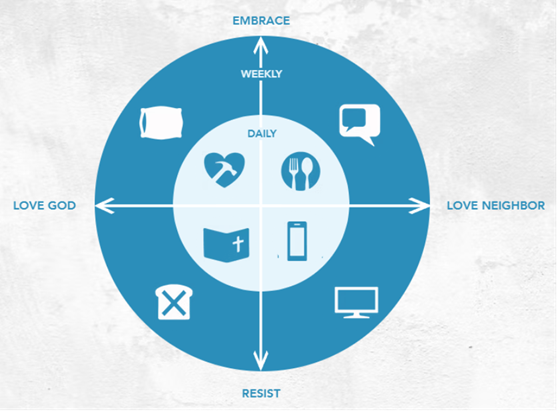
Daily habits
- Kneeling prayer three times a dayThey don’t need to be long prayers, but training ourselves to turn to God as the day begins and ends, as well as during the busy midday, forms us in love to remember that it’s not about us, but God and those we serve.
- One meal with others
We were made to eat and we were made for community. Each day benefits from sharing a meal in community. - One hour with phone offIt is so easy to be present with others, and not actually present. Everything else can wait for one hour, giving our full selves to people we love with undivided attention.
- Scripture before phoneOur day begins best when we first listen to our Creator’s voice before all the messaging and stress our phones will inundate us with.
Weekly habits
- One hour of conversation with a friendWe need intimate connection and vulnerability. Weekly touchpoints of openness, honesty, and love shape us in gospel-centered relationships.
- Curate media to four hoursStories shape us, and we’re flooded with them in the media. Curating this media (carefully selecting what we take in and for how long) aligns our hearts to uphold beauty, love justice, and turn to community.
- Fast from something for twenty-four hoursIt can be food or other comforts. Fasting shows us who we really are, reminds us of the world’s brokenness, and leads us to rely even more on Jesus.
- SabbathWe were made to rest, and the world doesn’t depend on our constant work. Enjoying Sabbath is a countercultural way of embracing our limitations and resting in what God has perfectly accomplished for us.
When I first got the book, I was skeptical. There is no shortage of latest-and-greatest ten-simple-steps life hacks out there for a new and better you, and I find they all just lead to more guilt. I was pleasantly surprised by The Common Rule.
It is gospel-saturated.
Earley understands that more guilt won’t change us for the better. He’s not trying to be the latest guru or pretending to be our mother. He speaks from a place of humility and undying gratitude for the gospel. The motivation in each chapter grows from confidence in the love of God and his perfect salvation for sinners.
When summarizing these habits, Earley clarifies: “If you’ve read any of this book thinking you can muster the good life out of a few daily and weekly practices, you’re reading it backward. Love has first come to us. Anything and everything else we do comes after that. All these things are simply a response to this astounding love…
“Place habits before love, and you will be full of legalism, but place love before habits, and you will be full of the gospel. God’s love for us really can change the way we live, but the way we live will never change God’s love for us” (155). Dude, preach it!
It’s the right cocktail of old school and contemporary.
I think this is what makes Earley’s approach unique. He’s addressing real issues people have wrestled with since the fall into sin. He’s not claiming he’s come up with something new; many of the concepts are borrowed from monastic orders. But he addresses them to people who have smart phones, who live in a culture that worships business, and who are constantly connected but lonelier than ever. His suggested habits meet these same yet culturally new challenges well (I couldn’t stop discussing them with my wife as I read the book). But, in my opinion, the principles behind the suggested habits are the most valuable part of the book. Even if you don’t implement all or any of his habits in your routine, you will certainly benefit from the principles he explores.
It gets vocation right.
I didn’t catch Earley ever using the word “vocation,” but the concept runs throughout his book. The goal he encourages striving for is not so much self-improvement or self-care, but increased love for God and others. He repeatedly emphasizes the importance of developing habits in community to allow us to serve the people around us more effectively in the various roles God gives us. For example, shutting the phone off for an hour a day allows us to be more present with our families. Fasting forces us to be more in tune with the brokenness of our world and to open our eyes to our neighbors’ struggles. Kneeling to pray midday resets our hearts from self-centered work to work that is devoted to God and intended to bless our neighbor. Even curating the kind of media we take in, he says, should be in light of what will equip us to better serve others. He can even sound like a 2020’s version of Martin Luther in the way that he diagnoses contemporaneous culture and uses it to point to the cross.
It’s not a new life hack, but a pursuit of a beautiful life according to God’s design.
Earley says that doing the work of developing these daily and weekly habits is an art. It’s a pursuit of beauty—a beauty rooted in God’s design for our lives. This is what a life well-lived is all about: walking according to God’s design. It is refreshing to see someone posit an approach so unapologetically tight to Scripture, and to display it as the most beautiful way. Yet he finishes with anecdotes of his continued failures and need for grace. He inspires to continue developing spiritual disciplines, not out of obligation, but in beautiful gospel freedom.
It’s no surprise to learn that The Common Rule has been receiving awards among top Christian books. It is precisely what a distracted, burned-out, purpose-starved world is looking for. It would feel like unnecessary nitpicking to try to identify points to critique. I highly recommend this book for its wisdom and biblical guidance.