

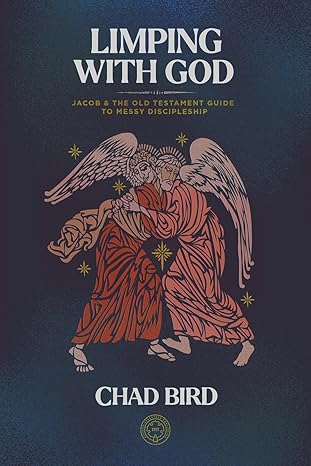
 A man and a divine messenger grapple on a canvas of deep blue. They are locked in a struggle on the surface, but their faces betray something deeper between them. Though intertwined in tension, their expressions evoke an embrace. This artistic interpretation on the cover of Chad Bird’s Limping with God: Jacob & The Old Testament Guide to Messy Discipleship animates the meditations contained within.
Bird is unapologetic in his focus on the gospel in this work. In this way, he balances the shelf of discipleship literature—a genre that tends to sag conspicuously on the sanctified living of its “heroes” of faith. His motive is not merely to be antithetical or innovative; rather, he sees a need for gospel focus amid the overemphasis on moralistic or glorified presentations of discipleship that contradict its formative essence and determining characteristic: Christ crucified. Therefore, with Jacob as the pattern, Bird confronts readers with the wondrous mystery of sinners sought by God, entangled in his love and touched by his grace in Jesus.
The Bible casts an honest picture of the Patriarchal families, not as paradigmatic heroes, but as constantly being sought, entangled, and wounded for life. Equating discipleship with notions of progress toward perfection is antithetical to the stories shared in the Old Testament, and Bird shows this throughout his work. Limping with God is a series of vignettes from the patriarch’s turbulent life that combine to form a biblical portrait of discipleship. There is no sustained interpretation or application of the life of Jacob. He does not promote a linear progression of faith, and there is no single, formal argument. Each meditation is like a drop in the bucket of Bird’s overall proposal of the essence of discipleship. The accumulation is a puddle reflecting the face of Jacob, and of you and me, broken, ever-changing, frivolous, liquid. There, faith sees Christ and his eternal, unchanging love. There, disciples see themselves as they are, broken images, made whole.
In chapter one, on the barrenness of Rebekah, he examines how God leverages time to press his disciples toward true faith, engaging for support not only the experience of Isaac and Rebekah. He then expands the topic to cover also the experience of Moses, the Virgin Mary, the Lord Jesus, his disciples, Lazarus, Mary, Martha, Bird himself, and finally, the individual reader. While applying the narrative to these extended contexts, he is careful to avoid allegory. The life of Jacob is not employed merely to substantiate Bird’s convictions. He maintains a balanced tone as he leads readers into interpretive ambiguities. His close reading of the Hebrew will alert a broad spectrum of disciples to details that may have eluded them on the last, if not many, previous meditations of the patriarchal narratives: for instance, Jacob is 77 years old when he deceives his father and flees… All Israel, save Benjamin, is born to the deceiver in Haran, now enslaved by his deception, to another deceiver… The seed of promise flowers in the wilderness of earned exile.
First and foremost, the pastoral heart of the book is evident throughout. Bird is not afraid to employ scholarly discussion, but he does so to serve the reader and not to confuse. He glides from source to source – classical to contemporary, pulp to popular, mythological to personal. A cacophony of voices finds harmonic resonance: Aeneas informs the U.S. Justice Dept., Diodorus of Sicily converses with NYT’s Best Sellers, the Targums employ Poe, Thomas a’ Kempis kneels with Paschal beside Luther and Lewis. Bird weaves a tapestry of literary and cultural references that keeps Christ in the center.
Readers familiar with Bird will find here his characteristic artistic prose. Some of the richest passages flow from a vulnerable soul pouring forth precious gall:
“When we have been seriously wronged, revenge can rapidly advance through the ranks of our desires to sit unchallenged on the throne of our hearts. This seething and rancid God, full of acidic hate, reigned within me for years. The homage he demanded were the liturgies of fantasy, whereby I plotted how to get even. The sacrifice he required was a life of positivity, hope, and joy, all to be slaughtered and bled out on the altar of reprisal… I have been a soldier in that land where joy goes to die and demons clad in the soiled garments of stolen dreams sing siren songs to woo the wounded to their soul’s demise. Do not go there, my fellow Esaus, do not go there. It is hell on earth” (47-48).
The title almost appears tongue-in-cheek, as Limping with God is not a practical spiritual “guide” to discipleship. There is little to no paraenesis, no sanctified suggestions from one who has lived it and speaks from the “other side.” Bird accomplishes his objective precisely by undermining these discipleship emphases. The great spiritual discipline incarnate in these pages, the fundamental definition of discipleship, and the guide provided by Jacob is “to know Christ and be found in him.” Disciples are not the seekers. Disciples are not defined by their vigorous pursuit of God, but by being those graciously sought, tirelessly pursued, and found in Christ.
Limping with God is loaded with wonderful illustrations for preachers, a veritable textbook on proclaiming Christ from the Tanak, beautifully pastoral. His devotions apply the life-giving Word when and where we often find ourselves unable. Profound in its depth and more so for its approachability, I heartily recommend this book for pastors, laymen, individual study, or (perhaps the author’s foremost intent) group study.