

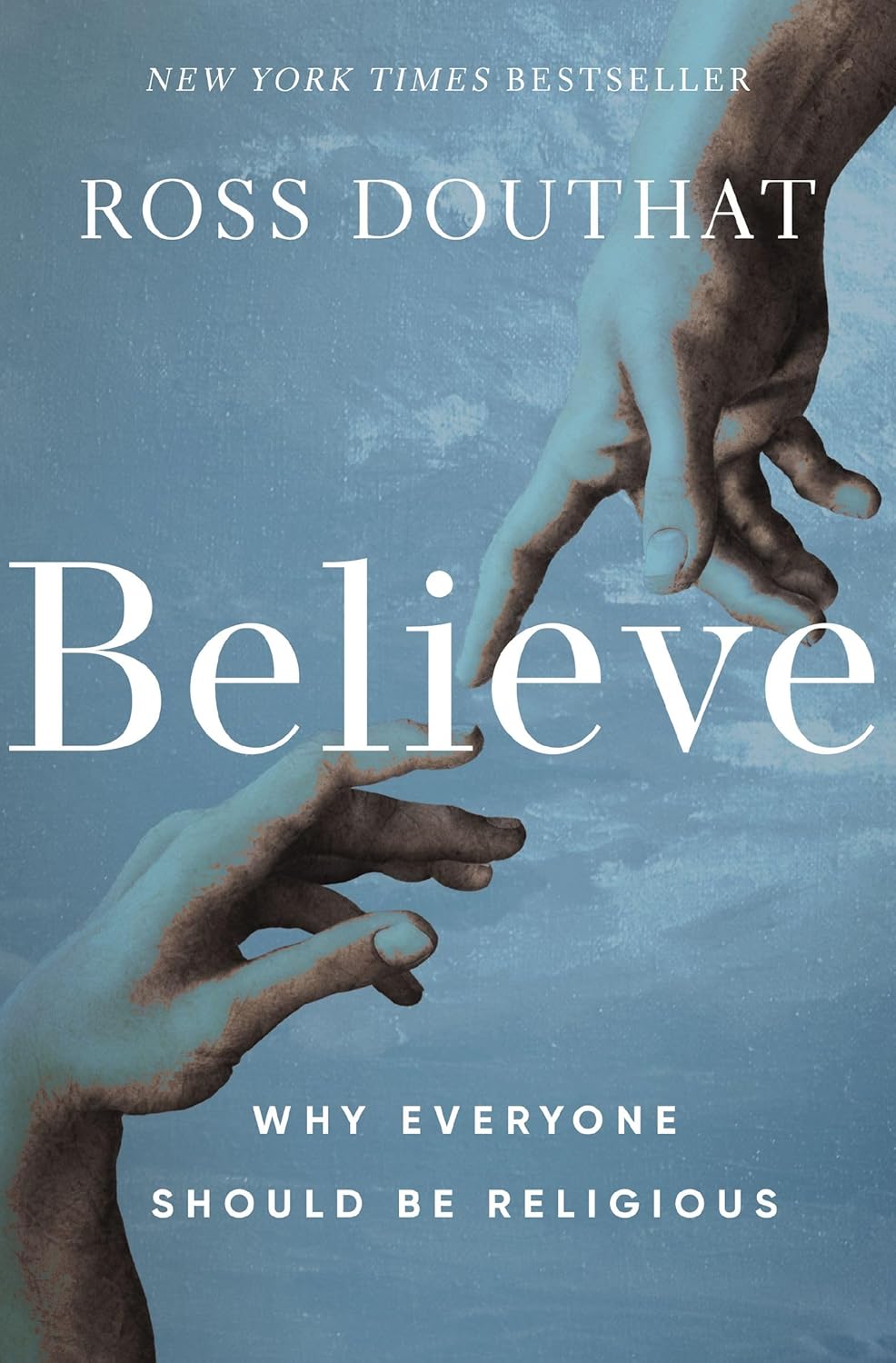
Believe. In what? Doesn’t matter!
This book can be summarized best in the title, Believe. The reader needs to believe in something. Anything. Ross Douthat, a columnist for the New York Times for over 15 years and a professing Roman Catholic, observes, “More and more of my readers seemed to experience secularism as an uncomfortable intellectual default, not a freely chosen liberation. More and more seemed unhappy with their unbelief” (2). For many, religion is gone, but something is missing. “There is more fear that a post-Christian or post-religious future might yield not liberal optimism and leaping scientific progress but tribalism, superstition, and despair” (3). Douthat’s purpose in this book is to show that belief is logical, not nonsense. “Reason still points godward” (6). He observes, “The spiritual and supernatural never really go away, and already the time of the new atheism is passing; already mystery and magic and enchantments seem to be rushing back into the world” (9). Douthat argues that one ought to believe in something and not just remain in atheism, agnosticism, or uncertainty. “My aim is for this book to be useful to readers who might take many different religious paths” (8). According to Douthat, any belief of any variety is better than atheism or agnosticism.
The first three chapters make the case for taking a religious perspective seriously and follow along well-trod apologetic lines: the universe and human life have design and purpose; consider the complexity and wonder of the human mind and consciousness; people have persistent supernatural and spiritual experiences. The next four chapters provide a guide for moving from a general religious disposition to a specific religious practice: joining a faith tradition, discussing choices and issues that might push you in one direction, or stumbling blocks that might come in your way. Only in the last chapter does Douthat explicitly encourage the reader to consider Christianity.
There is much good in this book. First, Douthat understands Western culture. “Many arguments for Christianity (or for other faiths as well) take as a given a religious or religion-friendly common culture that no longer exists, particularly among the general book-buying public in the Western world. So, it seems reasonable to start at a more fundamental level—with mere religion, not just mere Christianity—and work our way upward…” (7). Any quick demographic study will show American culture shifting further away from Christianity. Douthat understands this and wants to help others share Christ in our world.
Second, Douthat strikes a friendly tone. He almost never argues with the reader. While offering different perspectives from Christianity, Hinduism, and other religions, he never tears them down. He points out problems that might come from one’s belief. He is honest about objections to Christianity. Christians would do well to copy his amicable, compassionate attitude as they engage others.
Third, Douthat often presents apologetic points in a sensible, intelligible way. A few highlights: In chapter two he points out the complexity and wonder of the human mind. Humanity understands far less about us than we like to admit. In chapter eight he answers three common objections to religion and God: the problem of evil, wicked religious institutions, and why so many traditional religions care about sex. In the same chapter, he also defends the historical reliability of the Gospels.
Fourth, his approach is something of a steppingstone towards personal evangelism. Belief in something bigger than us is not a giant leap of faith. The next step is simple and small: asking permission to share what we believe about Jesus.
But it’s not all good. Douthat can get too deep. In chapters one and two he brings up quantum theory, the multiverse, the implications of AI on human consciousness, and other similar topics. While fascinating, these subjects might either lose an average person or track the conversation away from Jesus. In his defense, however, these same topics might go over well with certain individuals or in a youth, college, young adult, or similar setting.
The theological foundation of this book is perennialism. Douthat defines perennialism as “the idea that the permanent truths about God and the cosmos are encoded in different forms in different great religions, such that it makes sense to approach divinity through any of them, but not to imagine that any single tradition has sole access to the most important truth” (192). So, he says, “Since my argument throughout this book sometimes veers close to this point of view [perennialism] … and the broad evidence of mystical experience seems to point in a perennialist direction, why not just conclude that this theory probably has things right?” (192). Taken with grace, we can agree with this idea to some extent. There are certain truths every religion gets right, since all have access to the natural knowledge of God. Taken as Douthat presents it, however, it is a soft form of universalism or inclusivism.
Douthat sees salvation as a spectrum. Unbelief is the worst. Belief is better. Christianity, particularly Roman Catholicism for him, is best. “So, are you worse off, in your relationship to Islam’s great truth, as a practicing Christian than a religiously homeless agnostic? Surely not. As a Methodist you are arguably worshipping the same God as an observant Muslim, through the mediation of a figure, Jesus…” (177-178). “But for the general obligation imposed upon us all, no matter where we start and wherever we might hope to reach, a different Eliot line is apt: ‘For us, there is only the trying. The rest is not our business’” (182). In other words, Believe is an apologetic book written from the perspective of a modern day Roman Catholic. Free and full forgiveness through the blood of Jesus alone, the grace of God alone, and faith alone, all taught by the truth of scripture alone, are not the foundation of our salvation. What matters is trying and believing in something. Anything.
Douthat is a Roman Catholic. He avoids revealing his religious affiliation until later in the book. On the one hand, we can understand his approach. He is making an appeal for faith to the skeptic and does not want to push someone away. On the other hand, his belief of perennialism or inclusivism is the same doctrine taught and promoted by Vatican II in such documents as Lumen Gentium, “Those who, through no fault of their own, do not know the Gospel of Christ or His Church, but who nevertheless seek God with a sincere heart, and, moved by grace, try in their actions to do His will as they know it through the dictates of their conscience—those too may achieve eternal salvation.” This presupposition could have been made a little clearer from the beginning.
Pointing out the disenchantment of our modern age and the need for the mystical and spiritual can be a powerful point, as can talking about the wide assortment of spiritual experiences common to all people. But I was just not comfortable with the familiarity and approval Douthat has toward Pentecostal gifts, Catholic miracles, Eastern religious signs, and other mystical matters. In his defense, he notes that some Christians would associate many of these signs and miracles with demonic forces.
I recommend this book to a pastor or a well-grounded lay person. If one does give this book to a lay person, you would want to lay some groundwork and point out where Douthat’s Catholic perspective makes itself evident. There is much to learn from Douthat’s cultural intelligence, his friendly attitude, and some of his apologetic arguments. His general approach is good and might be useful in our post-Christian culture: gently and kindly encouraging someone to consider something beyond themselves, then using that opportunity to share Jesus with them.
This book also helps one understand a Catholic, universalist/perennialist/inclusivist perspective. Many people still call themselves Roman Catholic. Catholic baptisms and conversions trended up this year. The Roman Catholic church is still the largest Christian church in the world.
Finally, one of the most common religious beliefs I hear is, “We all worship the same god anyway, right?” Believe gives an in-depth explanation of that belief and could help the reader to respond lovingly.
You don’t need to go and buy Believe immediately. It’s not a must-read book. But if you’re looking for a new and fresh apologetic book, it has much to offer.