

How could Israel behold the daily miracle and partake of the bread of angels (Psalm 78) and later say, “We are disgusted by this worthless food!” (Numbers 21, EHV)? Familiarity breeds contempt. See enough jets daring the eagle’sflight, and you no longer marvel at people safely hurtling through the sky. How easily sin and Satan could have their way and tempt us to something similar with our Lord’s miraculous Supper.
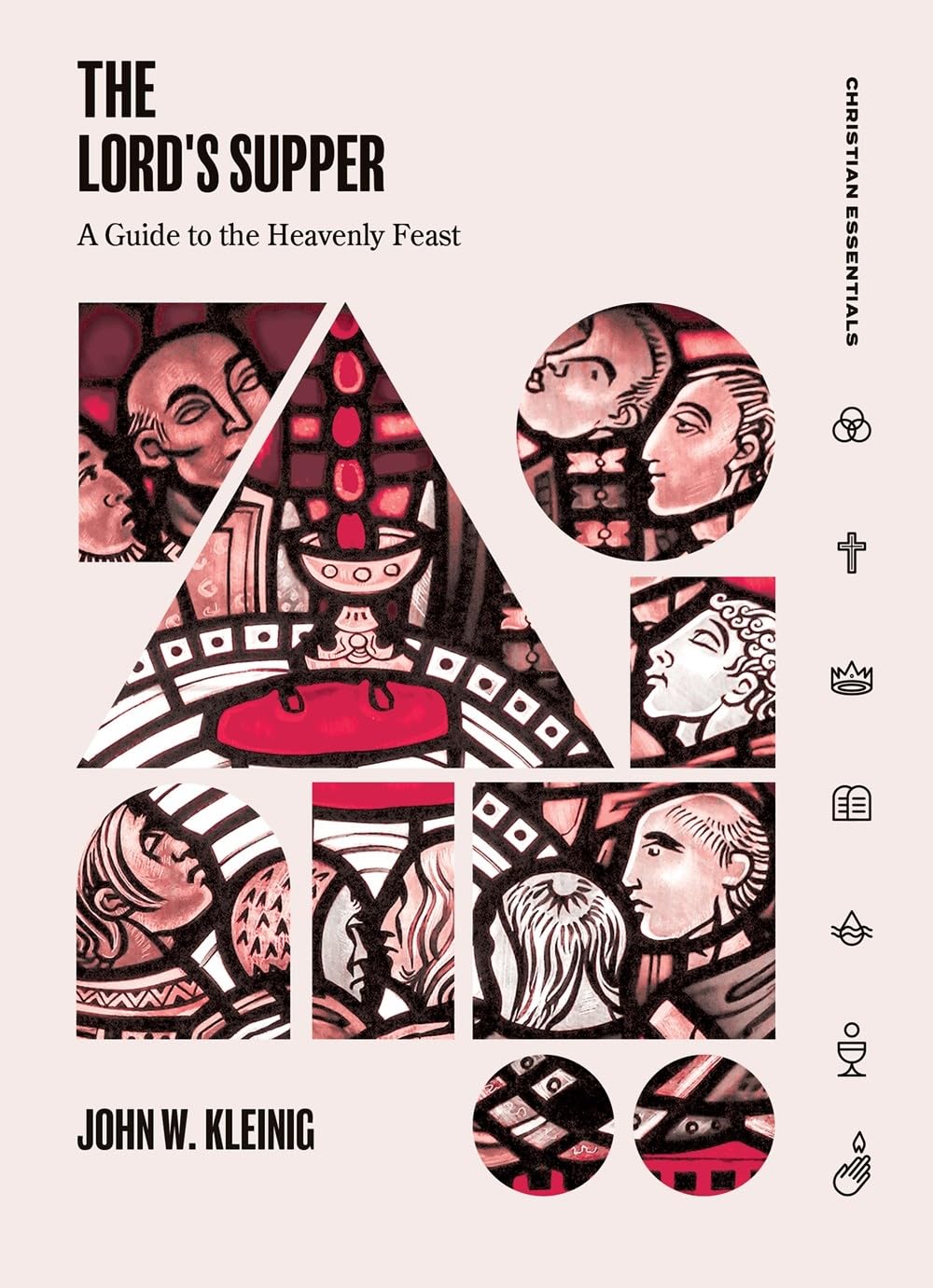
The antidote to growing cold to this marvel is not by having the Sacrament of the Altar less frequently but letting God’s Word open our eyes to again see what a glorious, saving mystery he unfolds for us under bread, wine, and words. John W. Kleinig’s The Lord’s Supper: A Guide to the Heavenly Feast provides such an antidote by taking the reader deeply into the Scriptures to renew both our wonder and our hunger for our Savior’s body and blood and all he bestows through it.
Kleinig’s approach toward the Supper is devotional and pastoral rather than systematic or academic. This becomes clear in the first chapter where he lays out his approach for this handbook on the Lord’s Supper (p. 1-10), and also in the introduction where he provides a brief order of “Prayer for Meditation on the Lord’s Supper” (XV-XVIII) meant to be used before each chapter. Lines from the closing prayer of this section (XVII) along with art between each chapter present a reminder to approach this mystery prayerfully and to listen deeply to what our Lord has to say. Each chapter ends with an appropriate hymn selection, since “even the most eloquent and passionate written prose fails to communicate the wonder of the Lord’s Supper” (p. 9). The author invites us simply “to attend to what Jesus himself has to say about this supper” (p. 9).
Kleinig carries out this purpose by not only taking a close look at what Jesus said and did when he instituted the Lord’s Supper, but also by connecting it to the wider context of the Scriptures. From the Old Testament, he demonstrates how the Lord’s Supper is no afterthought, but the fulfillment of so much of the Old Testament—the sacrifices, sacrificial meals, Passover, God eating with his people on numerous occasions, sprinkling the priests with blood, the blood of the Covenant (Exodus) and the blood of the New Covenant (Jeremiah 31).
From the New Testament, Kleinig naturally focuses on the Words of Institution as well as Jesus eagerly longing to eat the meal with His disciples. He also spends a considerable amount of time on the seven meals at which Jesus was a guest or host in the book of Luke (p. 75-86) to demonstrate “how all of them throw light on the ongoing celebration of the Lord’s Supper by his disciples after his death and resurrection.” Two chapters out of twelve (IX and X) focus on John 6 and Jesus’ Bread of Life Sermon. Kleinig appropriately references 1 Corinthians in a number of places. Thoughts from Hebrews dominate in Chapter X to show us how heaven and earth are brought together in Christian worship, but especially in the Lord’s Supper.
While carrying out his devotional approach, Kleinig is both scholarly and pastoral. Four tables are featured in the book, carefully laying out Jesus’ actions in instituting the Supper (Table 1, p. 36-37), the Words of Institution (Table 2, p.38-39), the meals in Luke (Table 3, p. 82-83) and the Bread of Life discourse (Table 4, p. 108). Each chapter opens with a relatable introduction leading into an aspect of the Supper, followed by a conclusion that drives home the point to the reader.Through his use of scripture quotes, Christian hymnody, and practical illustrations, Kleinig makes clear his reverence and appreciation for Jesus’ heavenly gifts in a way that leaves me hungry for the Savior’s Meal.
The book is a quick and enjoyable read. The 152 pages of text are on small pages, interspersed with prayer and art. My second read through only took one afternoon. However, there is plenty to ponder that makes this book far meatierthan a quick flip through its pages might expect. Especially valuable are the portions connecting the Old Testament to the Lord’s Supper.
While not taking an apologetic or dogmatic approach, Kleinig shows he is a confessional Lutheran in his understanding of the Lord’s Supper. He presents the doctrine of the Real Presence in a simple, irenic way by simply saying what Scripture says. “We do not understand how this happens (delivers his body and blood to his disciples), but we do know that he does this in his Holy Supper. We know this by what he tells us” (p. 122). I found nothing to criticize in the book when it comes to the real presence or the benefits of the Supper. It is certainly not (nor ever claims to be) a comprehensive book on every related question to the Sacrament.
Two topics may raise some questions and present challenges for confessional Lutheran readers. Chapter VII: The Unseen Host (p. 75-86) covers the seven meals in Luke where Jesus was either a guest or host. Kleinig’s states Luke uses these to teach about the Lord’s Supper and its ongoing celebration among Jesus’ disciples. This was the first time I have heard that idea introduced. Kleinig’s arguments are intriguing and there is no doubt each meal teaches something about Jesus and his gifts that are in common with the Lord’s Supper. However, since Luke never comes out and says that is his intent, one could see Kleinig as “reaching” regarding these meals serving as a sermon on the Lord’s Supper. There is nothing objectionable about anything that is taught with these points, but the question remains: can we say with certainty this is what the Holy Spirit through Luke was doing?
More surprising and possibly more challenging to many Lutheran readers is what Kleinig maintains in both Chapter IX: Bread From Heaven (p. 103-113) and Chapter X: How Can He Do This? (p. 115-123). In both sections he maintainsthat in the latter portion of Jesus’ Bread of Life Discourse, Christ is directly speaking and teaching about the Lord’s Supper. I remember well my college Greek professor giving us a long list of compelling reasons why John 6 is not about the Lord’s Supper. Luther and several confessional Lutheran commentators I consulted all also held to the view that Christ is not directly speaking about the Eucharist in this section. Kleinig avoids the incorrect conclusions of both the Reformed and the Roman Church in connection with John 6, and his applications are fine in a vacuum; but is Jesus actually discussing the Supper here (as many of the Church Fathers held) or is the Lord doubling down on the metaphor of faith as spiritual eating?
I do recommend this little book for several reasons. It serves as a personal devotional resource for anyone to re-open their eyes to the wonderful table Jesus sets for us in this divine meal. For the preacher, the book has value to augment text studies on the various readings for Maundy Thursday. Useful exposition and practical illustrations along with Kleinig’s winsome style provide many ideas for preaching on the Lord’s Supper from the texts covered in the book. This little volume could also be used as an outline for a Bible study or small group study focusing on the Supper. In general, this book serves as a useful example of letting Scripture speak to us richly of God’s abundant mercy and the astonishing grace that invites us to the Lord’s Table.