

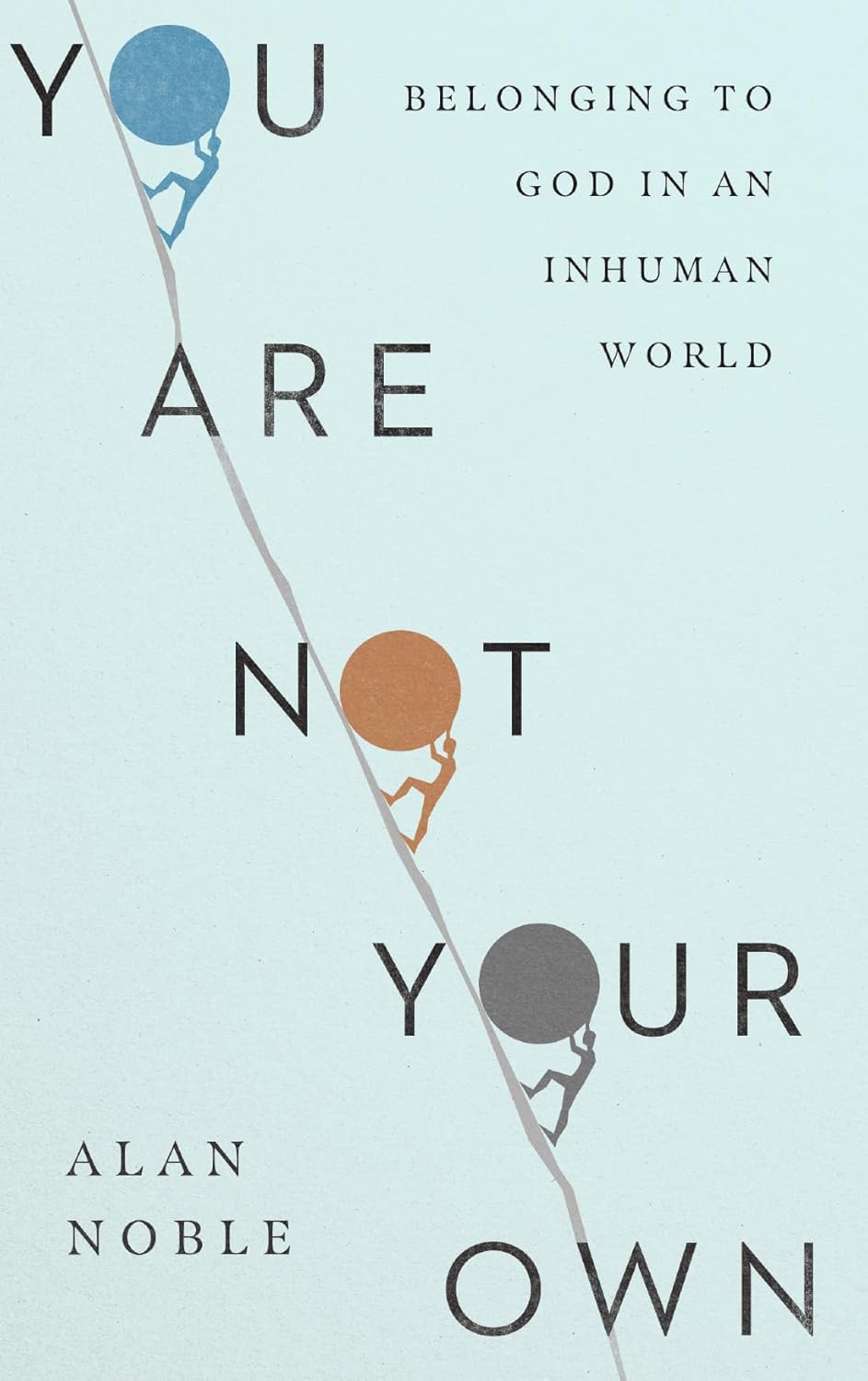
 As the Western world secularized and attempted to sever its connection to its Creator, more people came to believe that their lives are their own. They alone have the authority to define, build, and enjoy their lives as they see fit. To many, this newfound autonomy (the notion that our lives are “our own”) promised to usher in an era of fulfillment, joy, freedom, and well-being. Instead, modernity and its gods came and brought anxiety, despair, and burden.
Alan Noble, Associate Professor of English at Oklahoma Baptist University, wrote You Are Not Your Own: Belonging to God in an Inhuman World as a guide to understanding, diagnosing, and pushing back against the various malaises of modernity. Rather than a superficial scan of symptoms, he takes readers on a thoughtful and accessible dive into the problems facing both Christians and the broader Western world in our day and age. Along the way, he introduces us to key thinkers in modernity, such as Jacques Ellul, Zygmunt Bauman, and Charles Taylor, as well as some more familiar authors like T.S. Eliot and C.S. Lewis.
The book begins with an honest, heartbreaking evaluation of our current era of anxiety, depression, and dehumanization. It then analyzes the ways in which broader society contributes to modern maladies and how modern man tries to cope with such problems.
The core of the problem, according to Noble, is autonomy, that is, self-rule, or, to use the book’s title, the notion that we are our own and have the authority to live how we want. While autonomy may seem liberating, it also means living in a world without intrinsic morality or meaning, devoid of divine guidance or comfort. To live as if your life is your own comes with the burden of constructing your own identity, convincing yourself of your own morality, finding meaning in a meaningless world, etc. Such burdens lead many into resignation, self-medication, or ever more feeble attempts to bear the weight of the world on their shoulders.
Noble then directs his readers to the Heidelberg Catechism, where it reads, “What is your only comfort in life and death?” “That I am not my own and belong with body and soul, both in life and in death, to my faithful Savior Jesus Christ.” Relief from the burdens of modern life comes not from accelerated pace, increased consumption, higher achievements, or self-medication, but from understanding that we belong to the God who both created and redeemed us. This belonging, though it cuts against our world’s desire for autonomy, frees us from various burdens and gives us identity, meaning, and justification.
As he concludes the book, Noble refrains from pat solutions or simple answers, nor does he draw up a list of hacks or tips for readers. Instead, he calls readers to a deeper understanding of their human troubles and a deeper appreciation for and acceptance of Christ’s redeeming work. He gives advice on how to resist the values and systems of our modern age and find rest in Christ, knowing that he will take care of everything.
Overall, Noble’s book is refreshing, relevant, and insightful, if not a bit melancholy at times. Noble does his best work in diagnosing modern man. By drawing on thinkers like Ellul, Bauman, Taylor, and others, he explores issues at a deeper and more thoughtful level than one may find in other Christian literature. As he speaks about the issues, he gives readers more insight than a casual screed against screens or another lament about secularization. He takes readers down to the level of the human heart and all its complexities.
Though much of the book builds off the previous work of other sociologists and philosophers, it is no less worthwhile. The first two thirds of the book alone serve as a worthwhile primer on various thinkers and poets, whose insights have only grown more–not less–relevant.
His answer to modern ills has a distinctly Reformed flavor: rather than idolizing autonomy, he turns readers back to the Heidelberg Catechism. While Lutheran readers will not object to the fact that we belong body and soul to Jesus, they may find themselves wishing for a different emphasis. Though Noble emphasizes the Creator-creation distinction, he doesn’t downplay the redemptive work of Christ. Nevertheless, I still found myself wishing he grounded the Christian response in Luther’s joyful explanation to the Second Article of the Apostles’ Creed, rather than the more matter-of-fact Creator-creation distinction.
Finally, his conclusion may leave readers with mixed feelings. On the one hand, his refusal to give “easy as” or “if only” solutions is a breath of fresh air among Christian books. Giving quick fixes can just as easily become another burden on the heavy laden, especially when the quick fix doesn’t fix as much as it promised. On the other hand, his conclusion meanders, without the blazing hope, beaming joy, or rousing call to action that readers may expect in the final chapter. I leave it to readers to decide whether his take on modernity is realistic and refreshing or a touch too bleak.
Overall, this book receives my recommendation. While I cannot endorse all his emphases or conclusions, I found many of the ideas illuminating, insightful, and satisfying. To say that a problem is the result of sin is, of course, true, but to set it in a historical and cultural context is to begin the process of finding more complete solutions to such problems. If one is searching merely for another program, initiative, or quick fix, they would do well to look elsewhere. Noble refuses to diminish modern struggles by suggesting that a minor tweak will liberate readers from society-wide issues. But for someone who wants a thoughtful, accessible, and honest assessment of modern anthropological issues, Noble’s book is well worth the investment.